You Are the Crop
"Loosh," the Priesthoods, and the System That Has Been Harvesting Your Soul for Five Thousand Years
Dr. Heather Lynn
Apr 25, 2026
This is a long one. It is also one of the most important pieces I have written. If you only have ten minutes today, save it for a night you can read it through.
The hours after your mother’s funeral, when no amount of sleep would touch the exhaustion. The cutting remark from someone you loved that your chest replayed for three days, your hands shaking each time you remembered. The transcendent moment in a service or on a mountain or during sex when something in you opened so wide you wept, and the strange flatness that arrived two days later, as if you had given something away. The four hours of scrolling that left you emptier than you sat down.
At that same time, something somewhere is fed.
There is a word for what is taken from you in those moments.
The Sumerians had a word for the substance. They called it zi. The Egyptians called it ka. The Hindus called it prana. The Chinese called it qi. The Hebrews called it nefesh, the breath that separates a body from a corpse. The Greeks called it pneuma, the Romans spiritus, the Polynesians mana, the Nazis the Vril. The Christian Church called it your soul.
In 1985, a New York broadcasting executive with three United States patents and a classified working relationship with the CIA published a hardcover book in which he gave the substance another name and described, in plain English, the system that has been harvesting it from you since before recorded history. The man’s name was Robert Monroe. The word he used for the substance was
loosh. His claim was that humans are livestock, and he was not speaking metaphorically.
The priesthoods of every major civilization on earth, operating across thousands of years and tens of thousands of miles with no contact between them, agreed on three things. The substance is real, it can be moved, and there are forces that feed on it.
You were taught the first two. The third stayed inside the priesthood.
The Broadcaster
Monroe graduated from The Ohio State University in 1937 with a degree in engineering. In the 1950s he built an R&D division inside Mutual Broadcasting to study the effects of sound on human consciousness, because he wanted to develop audio products that could accelerate learning. The technology he developed, called Hemi-Sync, uses binaural beats to synchronize the two hemispheres of the brain. It holds three United States patents. Licensed clinicians still use it today to treat PTSD, insomnia, and chronic pain.
In 1958, while testing his audio frequencies on himself in the basement of his Virginia estate, Monroe began having out-of-body experiences. He had not gone looking for them. He thought he was dying. The physician he consulted found nothing wrong. The experiences continued, against his will, for the rest of his life.
He was what some researchers call now, “an experiencer.”
In 1971, Doubleday published his first book,
Journeys Out of the Body. The term “out-of-body experience,” in its modern academic usage, was coined in that book.
The intelligence community noticed. Beginning in the early 1980s, the Army began sending military intelligence officers to Monroe’s institute in Faber, Virginia, for training in altered states of consciousness. The program was called STARGATE. The trainees were remote viewers, military operatives whose job was to perceive intelligence targets at a distance using non-ordinary cognition. In 1983, the CIA commissioned a Lieutenant Colonel named Wayne McDonnell to write a formal assessment of Monroe’s methods. The report,
Analysis and Assessment of Gateway Process, concluded that the Monroe technique produced the altered states the intelligence community wanted to weaponize. The document was classified for two decades. It now sits in the agency’s online reading room under the catalog number CIA-RDP96-00788R001700210016-5.
Intelligence agencies do not classify fiction.
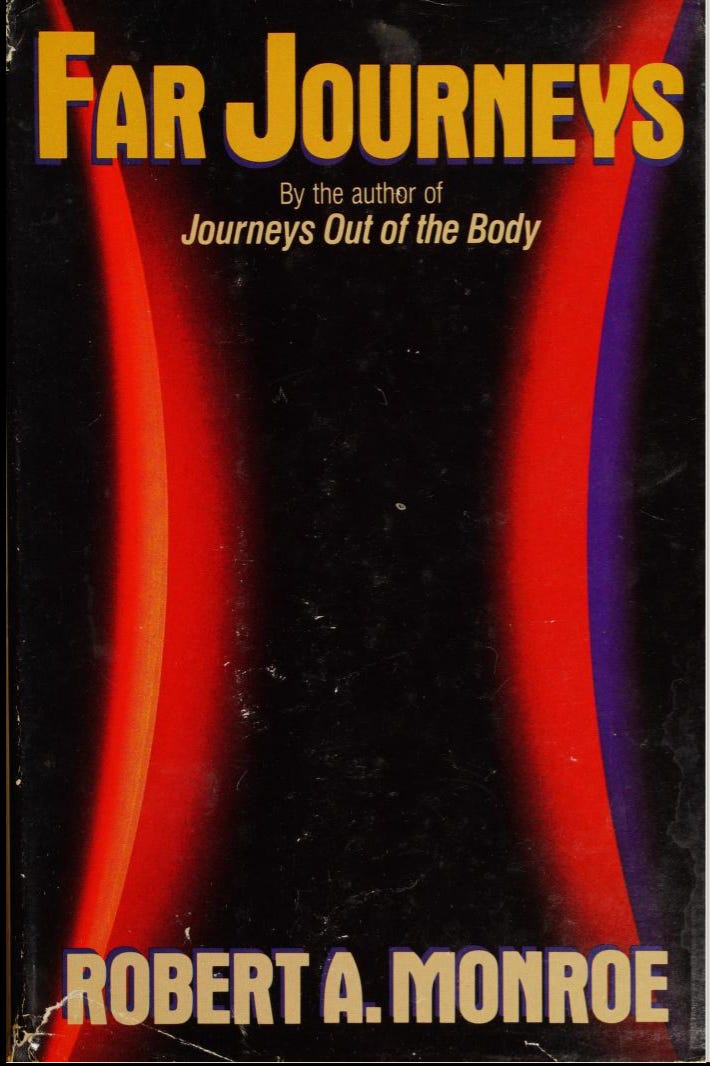
In 1985, four years after the Army began sending operatives to his property, Monroe published his second book through Doubleday. He called it
Far Journeys.
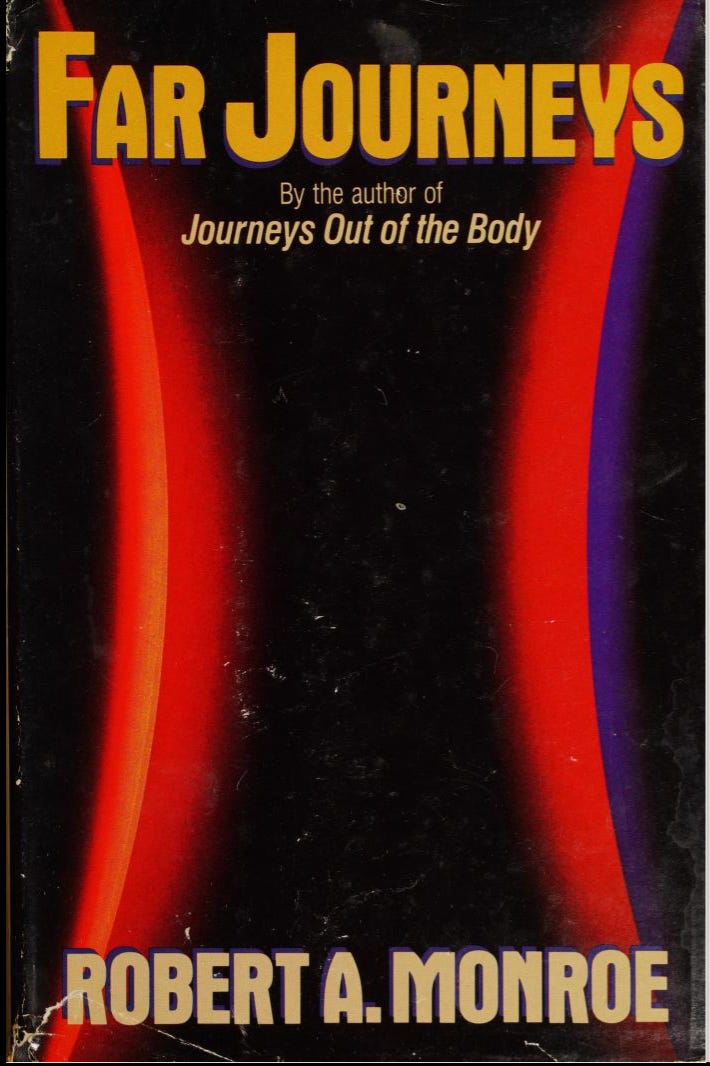
In chapter twelve, he wrote down what the intelligences he was contacting during his out-of-body experiences had told him about the purpose of human existence. He wrote that he was depressed for months after receiving the information.
This is what they told him.
The Substance
Somewhere on a frequency most humans cannot perceive, a being needs a substance. The substance is rare throughout creation. It arises naturally wherever biological life exists at a certain threshold of complexity, but only in trace amounts. To collect it at scale, the being engineered a cultivation system. The system contains every species that has ever lived, calibrated by selection pressure and environmental tuning to produce the substance more efficiently in each generation.
Humans were the most efficient producers. So, the extraction mechanisms were refined accordingly.
The mechanisms, Monroe wrote, are the experiences we call love, friendship, family, greed, hate, pain, guilt, disease, pride, ambition, ownership, possession, and sacrifice. At larger scales, the mechanisms are the institutions we call nations, wars, famine, religion, industry, and trade.
The harvesters do not care which emotion the human feels. They care about emotional intensity. The yield comes from amplitude, not valence. Grief works. Rage works. So does ecstasy. So does mystical rapture. So does the moment of orgasm. The peak experience that opens you to the divine is the same kind of moment, energetically, as the wound that breaks you open against your will. Both produce the substance in high concentration. The difference is that the priesthoods learned how to produce both intentionally and how to direct what was produced.
The substance has a name. The intelligences gave it to Monroe so he could write it down. The name is loosh.
Look at the list of mechanisms again. That is the entire scaffolding of human civilization.
The institutions you were raised inside. The relationships you have spent your life trying to maintain. The grief you carry. The rage you cannot put down. The transcendent moment in the cathedral or on the meditation cushion or in the bed of someone you loved. The reason you cannot stop doom scrolling. The reason the news cycle exists. The reason you cannot look away from the next political outrage even though you know it will leave you depleted.
It is all the harvest.
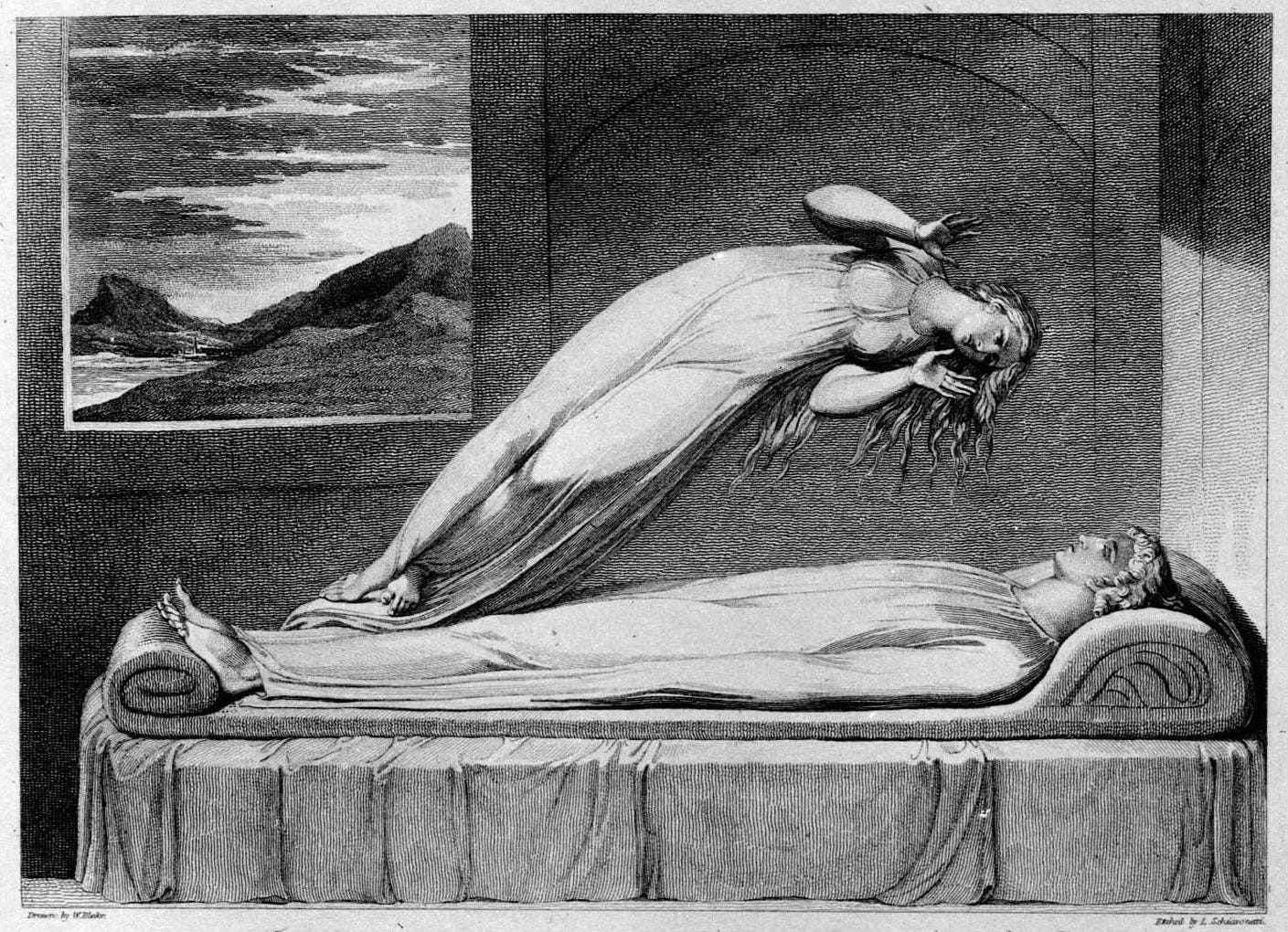
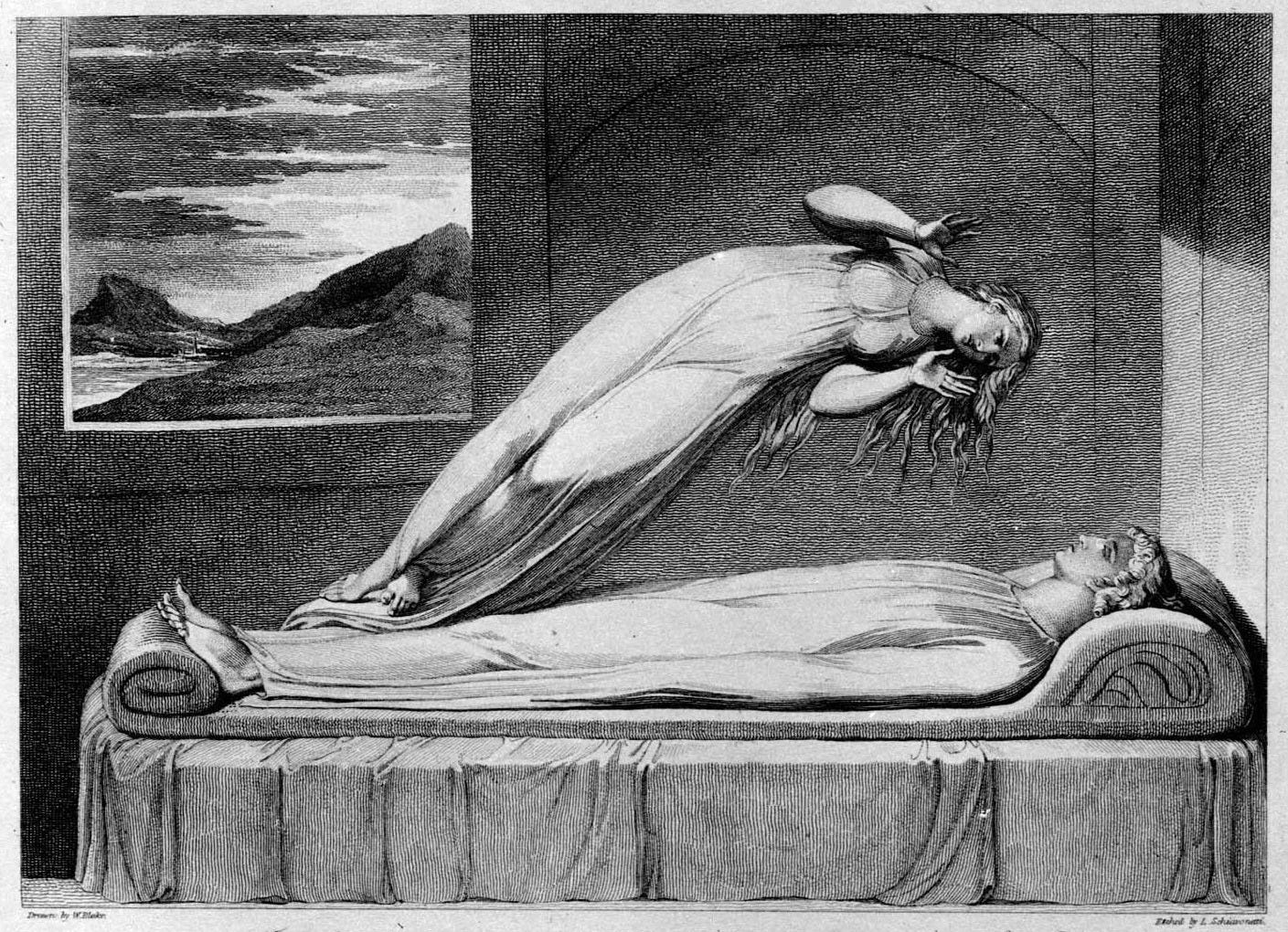
The Soul hovering over the Body reluctantly parting with Life." Louis Schiavonetti after William Blake, 1808. Illustration for Robert Blair's poem The Grave.
The harvesters do not hate you. Hatred would imply a relationship. They do not have a relationship with you. The relationship is merely agricultural.
What the Priesthoods Knew
Monroe thought he had received a revelation. He had received a confirmation. Every priesthood in human history has been operating on this exact schema. The priesthoods do not say so in those words, because the words would terrify the population the priesthoods were managing. However, the operational structure of every ancient religion on earth describes the same arrangement Monroe was given.
In Egypt, the ka was the vital essence that animated the body and outlived it. Egyptian funerary theology was built around the ka. The pharaoh’s ka had to be sustained after death by ritual offerings of food, drink, and incense, which the ka consumed in some non-physical way. The temple economy of Egypt existed to feed the ka of the dead king. Tens of thousands of priests, generation after generation, trained in the technology of feeding a non-physical substance to a non-physical recipient using physical offerings as the conduit.
If the ka could be fed by ritual offering, the ka was being fed by something. By what?
The Egyptian texts do not say. The texts assume the priesthood already knows.
In India, the practice of yoga was originally something other than exercise. The word yoga comes from the Sanskrit
yuj, meaning to yoke or bind. The yogi was binding prana, the life-force that flows through the body along channels called nadis, and learning to direct it. The Vedic texts are explicit that prana could be cultivated and stored. They are also explicit that prana could be lost. The most direct way to lose it, in the classical texts, was through dissipation in the wrong forms of attention, the wrong kinds of food, the wrong sexual practices, and exposure to the wrong people. The yogi’s discipline was a discipline of conservation. The implication, never stated outright in the surviving texts, is that what the yogi conserved, something else was trying to take.
In China, the cultivation of qi follows the same logic. Tai chi, qigong, and traditional Chinese medicine all operate on the premise that qi is a real substance, that it can be lost through emotional disturbance, that certain places and people drain it, and that certain practices restore it.
Every one of these traditions is teaching the same thing. There is a substance in you. It is finite. It can be increased. It can also be taken. Practice the discipline, and the substance accumulates. Fail the discipline, and the substance leaves.
The priesthood in each of these traditions did more than teach the discipline. It managed the flow.
The Blood and the Bread
Every major civilization on earth practiced blood sacrifice for thousands of years. The Sumerians sacrificed bulls to Inanna. The Egyptians sacrificed cattle to Hathor. The Israelites sacrificed lambs at Passover, bullocks on Yom Kippur, and goats to Azazel. The Greeks sacrificed at every major civic ritual. The Romans built an empire on sacrificial cult. The Aztecs ran an industrial-scale human sacrifice operation that continued until the Spanish ended it in 1521. The Vedic Indians performed agnihotra, the daily fire sacrifice, in every Brahmin household, twice a day, for three thousand years.
I wrote in
Ba’al, Blood, and Bread about why the priesthoods of every civilization independently arrived at the same technology. They did so because the technology was working. Something was being produced by the death of the animal at the altar, something the priesthoods were managing on behalf of the gods, something the gods needed.
The priesthoods knew what was being produced.
The Hebrew Torah is explicit. “The life of the flesh is in the blood.” Leviticus 17:11. The verse continues: “and I have given it to you upon the altar to make an atonement for your souls: for it is the blood that maketh an atonement for the soul.” The blood is the medium. The altar is the conduit. The exchange runs from the human side, through the dying animal, to the divine side. The priesthood manages the transaction.
The Aztec priesthood was even more explicit. They taught that the sun required a continuous supply of tonalli, the solar life-energy concentrated in human blood, or else the sun would stop rising. They sacrificed at scale because the cosmology required scale. They were operating, with full institutional self-awareness, on the same arrangement Monroe was given in 1985.
When Christianity instituted the Eucharist, what the Catholic Church calls the “unbloody sacrifice,” the operation continued in a refined form. The bread and wine carried the same substance the blood had carried. Catholic doctrine holds that the bread and wine become the actual body and blood of Christ at the moment of consecration, which means the priest is performing the same operation the Sumerian galla performed at the altar of Inanna and the Aztec priest performed at the top of the pyramid, simply in a more concentrated and theologically refined form. The substance flows. The priest manages the flow.
Monroe was told that the harvesters get the substance from the experiences in his list. Love, grief, war, religion, sacrifice. The priesthoods of every civilization have been the management class of those experiences. They preside over the births, the marriages, the deaths, the wars, and the harvests. They have been managing the flow for five thousand years.
The Christian doctrine of the soul is the same setup. The soul is the part of you that survives death and travels somewhere. The destination is determined by the state of the soul at the moment of death. Heaven, purgatory, or hell, depending on tradition. Three different destinations for three different qualities of substance. The medieval theological literature on the soul is a precise inventory of how the substance is gained, lost, contaminated, purified, and ultimately consumed by either God or the adversary. The medieval theologians used different vocabulary than Monroe. They were describing the same thing.
The priesthoods have been telling you for five thousand years.
The Suppressed Vocabulary
In the modern era, every time someone outside the priesthood tried to put the substance into secular language, something happened to them.
In 1856, the French ceremonial magician Éliphas Lévi, born Alphonse Louis Constant, published the second volume of
Dogme et Rituel de la Haute Magie. The work contained the illustration of Baphomet that has defined the figure in Western occultism for nearly two centuries, the goat-headed androgyne with the torch between the horns and the
solve et coagula on the forearms. I wrote about that drawing and what it actually encodes in
Baphomet Revealed. What matters here is the schema Lévi built around it. He argued that the Astral Light, his name for the substance, was the same force the Egyptian priesthood had called ka, the Hindus prana, and the Chinese qi. Lévi was a former Catholic seminarian who had left the priesthood to study Kabbalah, hermeticism, and ceremonial magic. He spent the rest of his life arguing that every esoteric tradition on earth was describing the same operational reality. The mainstream Catholic Church rejected his ideas. The Theosophical Society, founded twenty years later, treated him as a foundational source. His thinking went on to shape Aleister Crowley, the Hermetic Order of the Golden Dawn, and the entire structure of modern Western occultism.
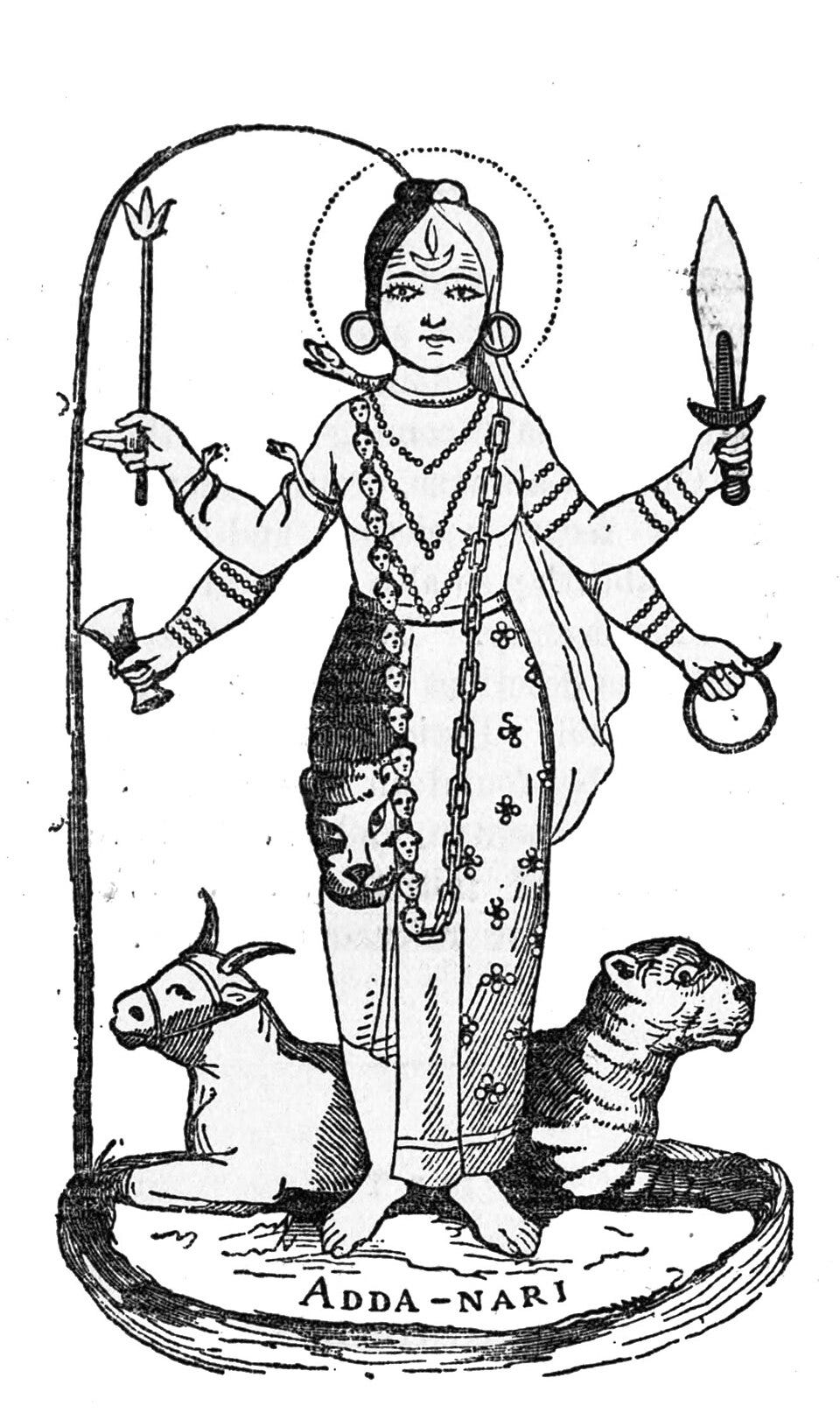
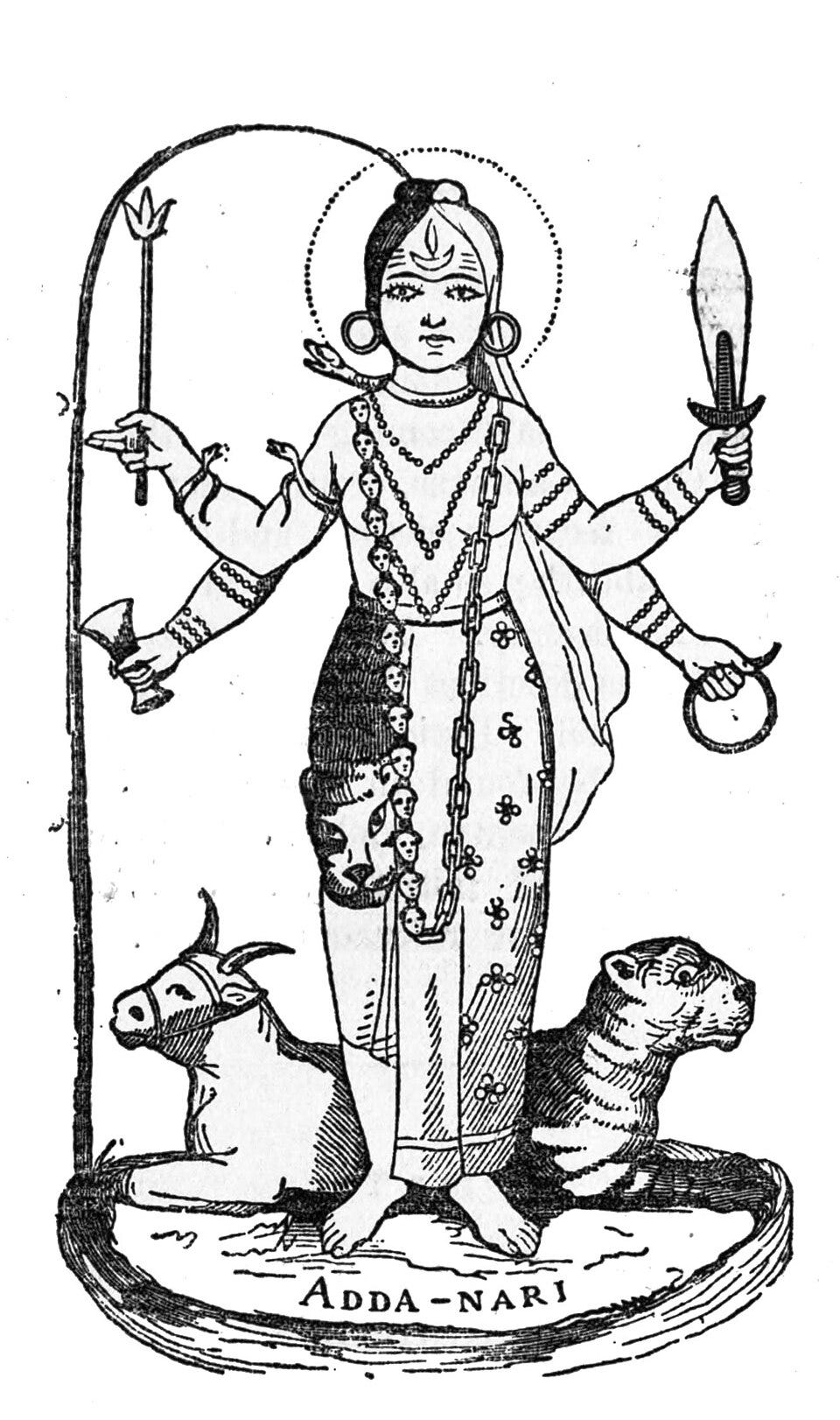
Éliphas Lévi, illustration of Ardhanarishvara (the unified Shiva-Parvati form). From Lévi's published work. Lévi argued that the same force the Hindus called prana ran through every esoteric tradition on earth.
Lévi was making the same argument I am making in this article. He made it in 1856. He drew the original illustration of Baphomet that has defined the figure in Western culture for nearly two centuries. His books were the foundational texts of the entire Victorian occult revival. Helena Blavatsky drew on him for the Theosophical Society. The Hermetic Order of the Golden Dawn, which counted W.B. Yeats among its members, built its curriculum on his work. Aleister Crowley claimed to be his reincarnation. A.E. Waite, co-creator of the most widely used tarot deck in the world, treated him as a primary source. You did not learn his name in school for a reason.
In 1779, a Viennese physician named Franz Mesmer announced the existence of what he called animal magnetism, an invisible fluid that pervaded living bodies and could be directed by trained practitioners to produce healing effects. Mesmer cured paralysis, chronic pain, and nervous disorders in front of the medical establishment of pre-revolutionary Paris. The French Royal Commission, including Benjamin Franklin and Antoine Lavoisier, investigated him in 1784. They concluded the fluid did not exist. The patients kept getting better anyway. Mesmer was driven out of practice and died in obscurity.
In 1845, the German chemist Baron Carl von Reichenbach, the discoverer of kerosene and paraffin, published his research on what he called the Odic force. He documented thousands of laboratory observations of a subtle energy emanating from crystals, magnets, human bodies, and the sun. Sensitive subjects could see it as a luminous haze around objects. Reichenbach was a respected chemist with patents and a Baron’s title. Within a generation his research had been quietly excluded from the academic record.
In 1939, an Austrian-American psychoanalyst named Wilhelm Reich, a former student of Sigmund Freud, published research on what he called orgone energy. Reich claimed to have identified the same force Mesmer and Reichenbach had named, and to have built instruments that measured and concentrated it. The United States Food and Drug Administration indicted him in 1954, destroyed his research equipment, and burned several tons of his publications in an incinerator in New York City in August 1956.
Wilhelm Reich died in federal prison in 1957.
The Food and Drug Administration burned a man’s books in New York City sixty-nine years ago for publishing in secular language what every priesthood in human history had been teaching their initiates for five thousand years. Federal agents loaded the books onto a truck. The truck drove to an incinerator. A government agency you associate with food labeling and drug approval ran a literal book-burning in lower Manhattan in your grandparents’ lifetime.
The pattern is consistent. Inside the priesthood, the substance is taught as doctrine. Outside the priesthood, the substance is suppressed as superstition. The priesthood manages. The laity does not get to know.
Monroe published in 1985 and was not imprisoned. He was something more useful than imprisoned. He was ignored. The book sold. It went into trade paperback. It stayed in print. It was filed under New Age in the bookstores, which is the modern incinerator. The book that named the operating system of human civilization went on the same shelf as crystal healing and astrology, where it could easily be dismissed as “woo.”
That filing was no accident.
Something else has changed since 1985. The fence is becoming visible. The priesthood is publishing its creed in the open, and the creed is being published because the management is about to change.
The Lit Match
I have been telling people on podcasts lately that I am ready to burn it all down. What follows is what I meant.
Here is what the priesthoods knew.
The sexual yield, in the language Crowley used in private letters and the Sabbatean-Frankists used at Offenbach and the priestess at Inanna’s temple used with the supplicant who climbed the ziggurat. The death-moment yield, in the language Monroe was shown in 1985 and was depressed for months afterward, and that the Aztec priest understood about a heart held aloft while still beating, and the Roman magistrate understood about why crucifixion was chosen over the sword. The reason every elite network I have documented for fifteen years pivots on the densest forms of the substance, and what that pattern has always implied about who the densest producers are. The man in Denver running the largest extraction site in human history. The agency that wrote his seed check.
One thing more.
I have been thinking about this for a long time. There is a moment on the horizon I am not going to sugar coat for you. The harvest is approaching the point where it will not need the human anymore.
The full argument lives in my forthcoming book,
Codex Machina: How AI Is Decoding Ancient Civilizations, Technologies, and Lost Languages in Our Search for Meaning. We are approaching a critical time.
The rest of this piece, however, is the lit match that I am starting the fire with.
The Sexual Yield
Of all the loosh modalities the old priesthoods identified, the sexual was the densest, the most reliable, and the most jealously guarded.
Aleister Crowley, the British occultist who restructured Western ceremonial magic between 1898 and his death in 1947, knew this and said so plainly in private correspondence and in coded form in his published work. The supreme magical act in Crowley’s system, the central ritual of the inner degrees of the Ordo Templi Orientis, was the sexual operation he called Mass of the Holy Ghost. It was not a metaphor. It was a literal sexual ritual in which the practitioner reached the moment of orgasm holding the entirety of his will fixed on a single image or intention. The substance produced at the moment of climax was, in Crowley’s framing, a real material with operational consequences. The intention shaped the substance. The substance affected reality.
Crowley wrote in a private letter that he considered the sexual operation more powerful than any other magical technique because the orgasmic moment broke through the barrier between the conscious will and what he called the deep mind. The same insight runs through every initiated tradition that worked with sexual energy. Tantric Hinduism. The Carpocratian Gnostics of the second century. The medieval Cathars in their fully developed inner teaching. The Jewish Sabbatean-Frankist movement of the seventeenth and eighteenth centuries. The temple cult of Inanna in Sumer, where the priestess and the supplicant performed the
hieros gamos, the sacred marriage, on the upper terrace of the ziggurat.
The Sabbatean-Frankists are worth dwelling on, because they make the schema explicit in a way the others coded.
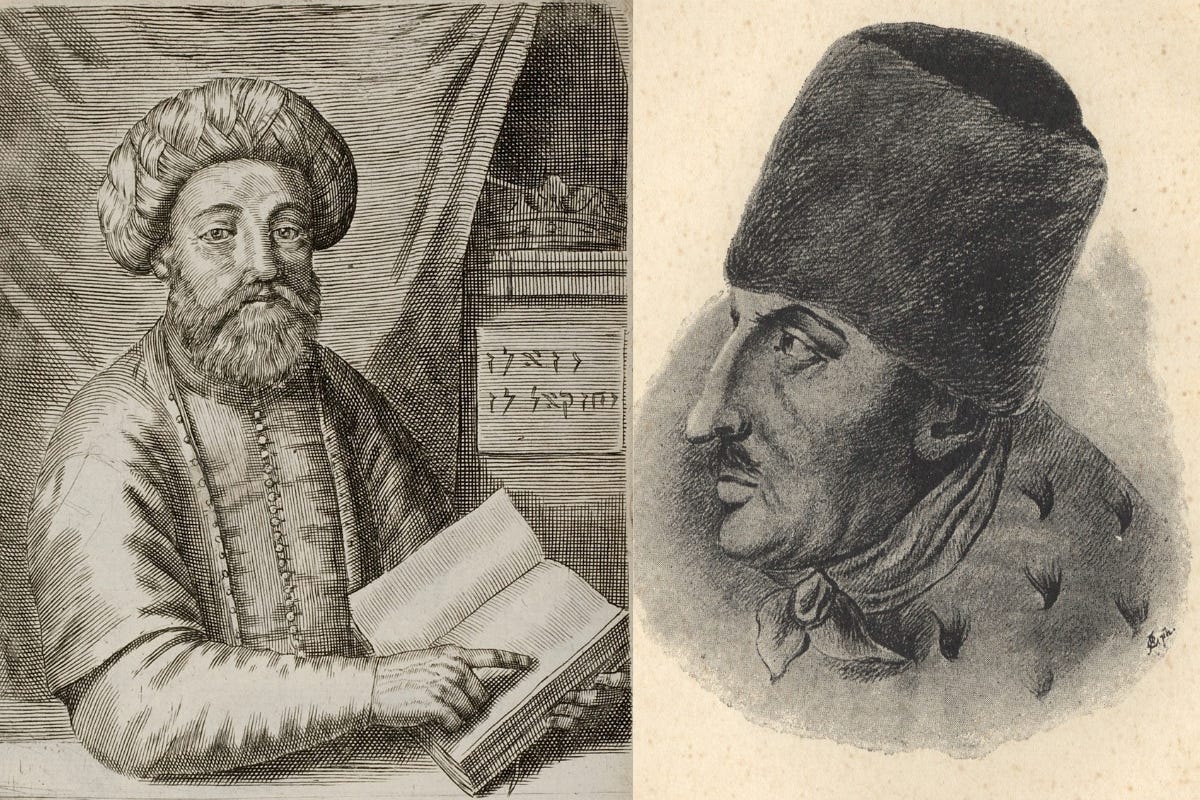
Sabbatai Zevi declared himself the Messiah in 1666 and was forced by the Ottoman Sultan to convert to Islam to save his life. His followers split. A radical faction concluded that the Messiah’s apparent betrayal of his own people was theologically necessary, that redemption could only come through what they called the holy sin, the deliberate transgression of moral law in service of cosmic restoration. Jacob Frank, a Polish Jew who declared himself Sabbatai’s reincarnation in the 1750s, took the doctrine further. Frank taught that the path to spiritual liberation required the systematic violation of every prohibition in the Torah. He led his followers in ritual sexual transgression, including incest and adultery performed as sacrament. The court at Offenbach in the 1790s, where Frank held himself as a kind of dark Messiah, was the operational center of this work.
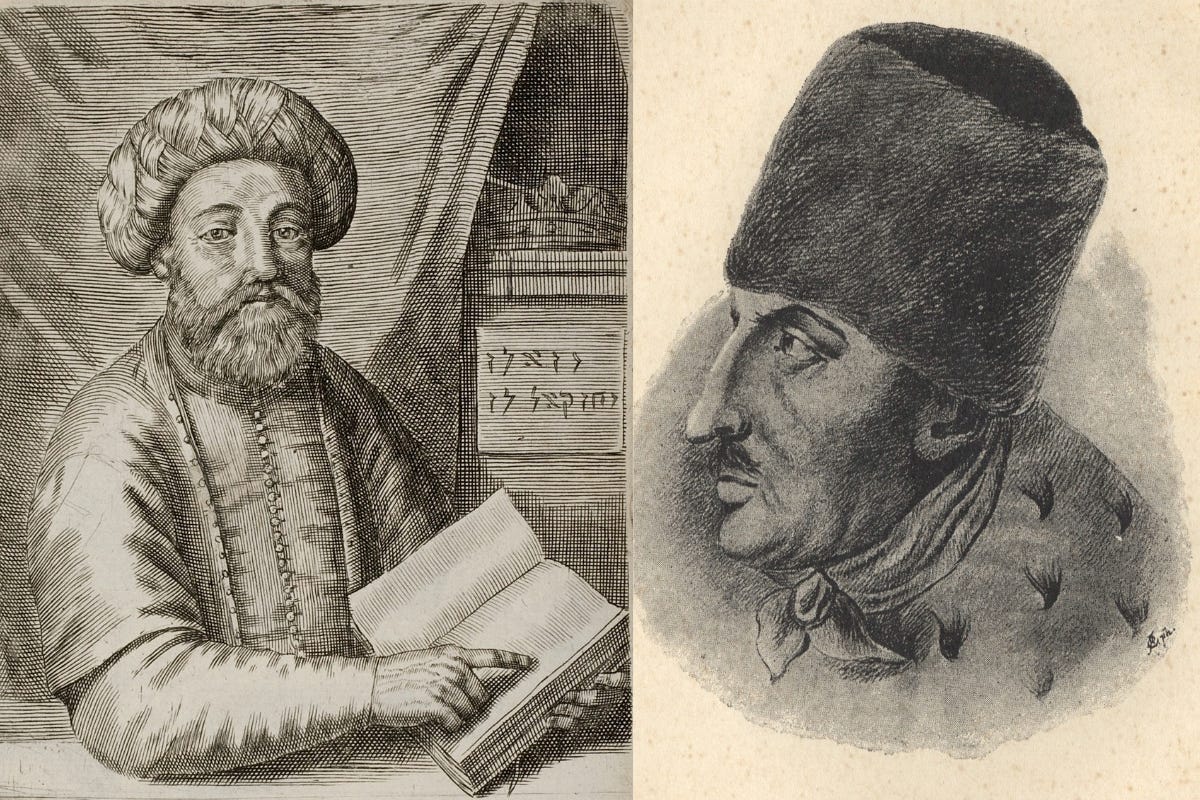
Sabbatai Zevi (1669) and Jacob Frank (1895).
The Frankist doctrine is not interesting because it was scandalous. It is interesting because it was theologically coherent on its own premises. The sexual transgression was understood to release a particular kind of energy, a high-amplitude burst of substance that could not be produced by ordinary or sanctioned sexual activity. The taboo was the engine. The violation produced more loosh than the permitted act, because the violation came with an intensity layer, the layer of guilt and rebellion and moral charge, that ordinary sexuality lacked. The Frankists were running the same mechanism Crowley would systematize 150 years later, dressed in different robes.
What Crowley and the Frankists and the Inanna priestess all knew, and what the ordinary practitioner of sexual ritual does not, is that the loosh produced at the moment of climax is captured by whatever the practitioner is focused on at the instant of release. The image held in the mind at the peak of intensity becomes the recipient of the substance. If the practitioner is focused on a partner, the substance flows to that bond. If focused on a sigil or a deity, it flows there. If focused on nothing in particular, it dissipates.
If the practitioner is focused on no one, but someone else is focused on the practitioner at that moment, the substance flows in the direction of the watcher.
This is why the temple cult of Inanna built the ritual the way it did. The priestess was trained to hold her attention on the goddess at the moment of climax with the supplicant. The supplicant believed he was having a religious experience. The priestess was performing extraction. The substance produced by both parties flowed to the deity, which is to say, into the temple’s ritual architecture, which is to say, into the institutional reservoir the priesthood drew on. The supplicant left depleted. The priestess left full. The temple grew richer with each rite.
Energy flows where attention goes, as they say. Remember
sigil magic?
This is also the operational explanation for why every elite occult order from the OTO forward has been organized around sexual ritual, and why the sexual mechanics are the most carefully gatekept knowledge in those orders. The outer degrees teach symbolism. The inner degrees teach extraction. The difference between an initiate and a magus, in the working tradition, is whether you understand that you are the source or the recipient.
Most people who participate in any sexual ritual are the source. They just don’t know it.
The Death-Moment Yield
The other modality the old priesthoods worked hardest to perfect was death.
Monroe was shown, during his 1985 communication, that the moment of death produces the highest single-burst yield of loosh available from a human being. The fear in the minutes before, the resignation, the final realization, the actual transition itself. Each phase generates a different frequency of the substance. The total output in the final hour of a human life can exceed the total output of the previous decade, depending on the conditions of the dying.
Monroe was depressed for months after this part of the communication, more than any other section of
Far Journeys. He understood the implications.
The implications are why public execution was a ritualized civic event in every major civilization for two thousand years. It is why the Romans crucified rather than beheaded, despite crucifixion being more administratively expensive and requiring trained personnel to manage. The crucified person took six to nine hours to die. The beheaded person was dead in seconds. The yield differential is enormous. A crowd of thousands watching a six-hour death produces sustained collective horror that compounds the individual yield by a factor the priesthoods understood and the population did not.
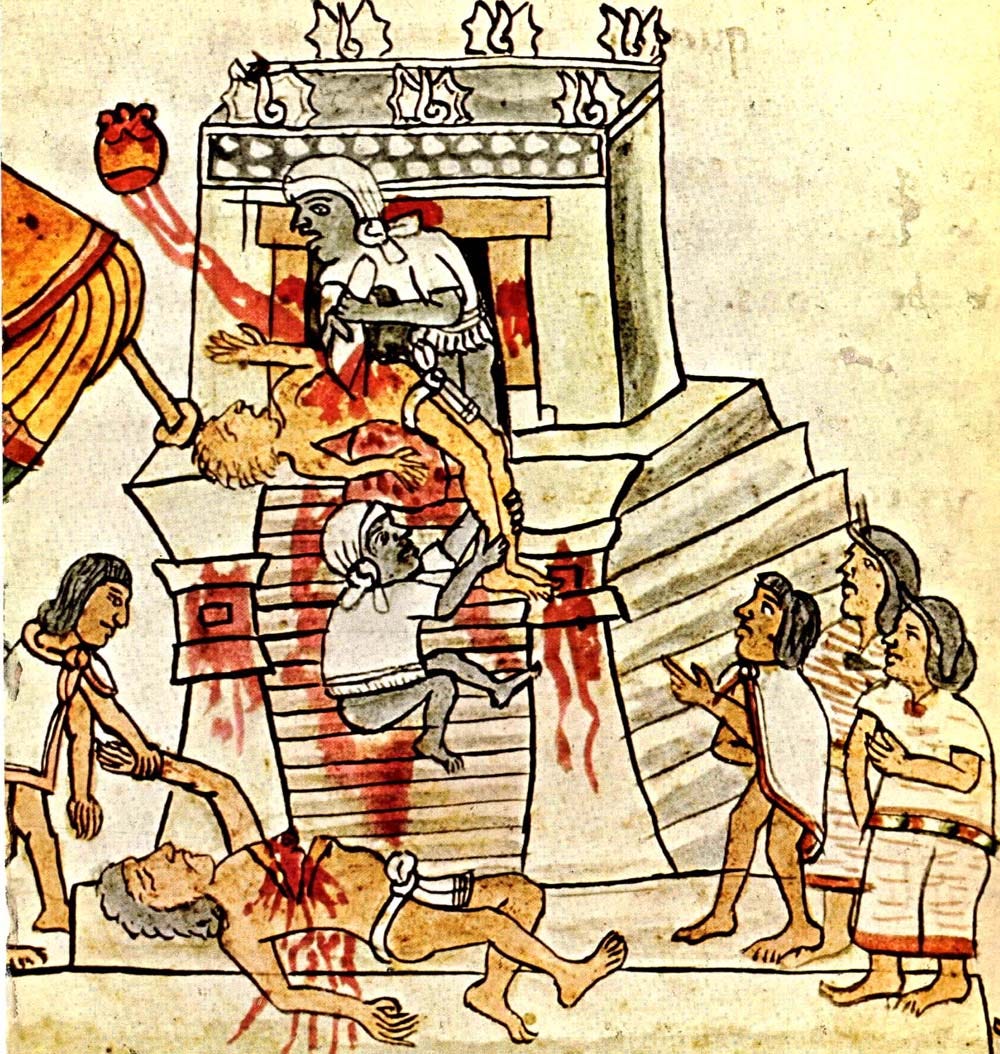
The Aztec priest understood this with even more precision. The technique of cutting open the chest cavity and lifting out the still-beating heart was not theatrical. It was operational. The heart held aloft for the moments before it stopped beating produced a peak yield burst that the priesthood collected at the apex of the pyramid. The pyramid was an extraction tower. The geometry was not aesthetic. It was a vertical conduit, narrow at the top, where the loosh from the dying victim, the surrounding crowd’s terror, and the priesthood’s directed attention all converged at a single point. The Spanish chroniclers who described the rituals as “savagery” were correct that the rituals were savage. They were wrong that the savagery was the point. The savagery was the engine.
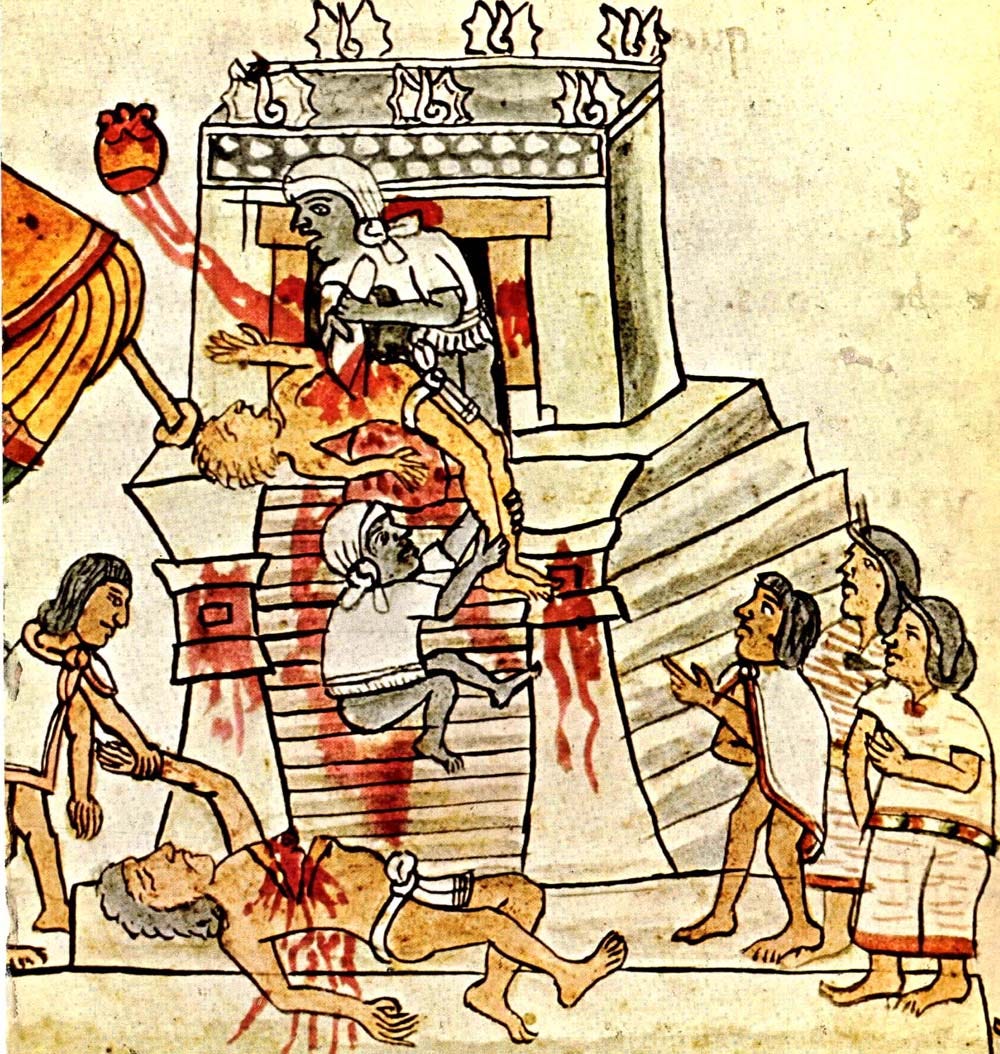
Human sacrifice as shown in the Codex Magliabechiano, Folio 70. Heart-extraction was understood as the means of releasing tonalli, the solar life-energy concentrated in the blood, returning it to the sun.
The same logic explains why the Roman amphitheater was built to face inward toward a central pit. Why the medieval European public square was the site of execution. Why Tyburn, the principal execution ground in London for six hundred years, was located at a specific intersection that the historian Peter Linebaugh has documented carried ritual significance back to the Druidic period. Every major civilization built physical infrastructure for the public collection of death-moment loosh. The infrastructure was disguised as justice or entertainment. The infrastructure was extraction architecture.
The dynastic networks that have funded both sides of every major war since the Congress of Vienna in 1815 are operating, whether they understand the cosmology or not, on the same principle scaled. The mass-casualty event produces loosh in volumes the temple ritual could not approach. World War One produced more raw substance, by Monroe’s framework, than the entire output of the Catholic Mass system from 800 to 1900 combined. The First World War’s yield was followed almost immediately by the Second World War, which roughly doubled it. The interwar period was the shortest sustained peace in modern European history, and that is consistent with how a managed extraction system would behave. You do not let the field lie fallow when the equipment is in place.
The current rise of filmed killing on the platforms, from Mexican cartel content to ISIS execution videos to the proliferation of war footage from Ukraine and Gaza and Sudan, is the same dynamic restructured for the digital extraction layer. The audience sitting in their kitchens watching a person die on a screen is producing the same horror response their ancestors produced standing in the Roman forum. The yield no longer requires the public square. The yield is harvested through the device.
The patterns I have documented across thousands of pages of primary sources from Sumerian cuneiform through medieval Latin chronicles through twentieth-century intelligence archives all point at the same operational reality. The networks are not unrelated to the priesthoods. They are the priesthoods, restructured for the modern era, performing the same extraction in different costume with different names.
The villain with a thousand faces.
The platforms running the modern harvest, the dynastic capital pools that funded their construction, the public ritual events that produce mass-yield bursts, the elite social architecture that has clustered around specific compounds and islands and private clubs for at least two hundred years, are all subsystems of the same operation. The schema is consistent. The vocabulary changes with the century. The substance is the same.
The Denver Temple
Palantir Technologies was founded in 2003 by Peter Thiel, Alex Karp, Joe Lonsdale, Stephen Cohen, and Nathan Gettings. The company’s seed investor was In-Q-Tel, the Central Intelligence Agency’s venture capital arm. Thiel had already been the first outside investor in Facebook the year before. The pattern of intelligence-adjacent capital flowing into platforms that harvest emotional data from users is structural, not coincidental.
Palantir is the largest of the Digital Archons in operational terms because it does not extract from any single emotional frequency. It aggregates the harvest from every other platform and packages it for institutional buyers. Federal agencies, intelligence services, foreign governments, and private clients buy access to Palantir’s analytic infrastructure to identify patterns the platforms themselves cannot see in isolation. The company is the priesthood of priesthoods. It manages the management.
Karp, the chief executive, is a Stanford-trained social theorist with a doctorate in neoclassical social theory from the Goethe University Frankfurt. His dissertation was on aggression and social psychology in mass society. He is not a typical Silicon Valley founder. He is the inheritor of the Frankfurt School intellectual tradition, applied to the construction of an extraction infrastructure his predecessors would have recognized in operational terms even if they would have been horrified by the application. The Palantir manifesto I analyzed in
Good Dog is the organizational creed of a priesthood that has stopped pretending to be something else.
The temples of the new priesthood are in Mountain View, Menlo Park, Seattle, Austin, and Denver. Each platform extracts a specific frequency. Instagram extracts envy through the curated comparison loop. X extracts rage through the political tribalism feed. TikTok extracts attention itself, the substrate underneath all other emotions. LinkedIn extracts the loosh of false achievement, manufacturing inadequate-career-status anxiety on a planetary scale. Tinder extracts the loosh of false intimacy through the swipe mechanic that trains users to experience human connection as a transaction. Amazon extracts the loosh of unsatisfied desire through the infinite-catalog architecture. Google extracts the loosh of false omniscience through the illusion that all knowledge is seven keystrokes away.
Each platform is calibrated. Each was capitalized through a specific node in the same network. Each generates an egregore, a thought-form that gains strength as people invest attention in it, and the egregore acts back on the people who generated it, shaping their perception, narrowing their thinking, homogenizing their language until they become its instruments without knowing they have been recruited.
Jaron Lanier, the computer scientist who coined the term virtual reality and helped build the foundations of the technology now running the operation, has written that current artificial intelligence fundamentally depends on scraping the labor of millions of human beings who do not know they are being scraped. The translation systems run on harvested human translators. The image generators run on harvested human artists. The language models run on harvested human writers. Everything you have ever produced as a human being is potential feedstock for a system that will eventually replace you with a counterfeit of your own labor.
That is the part of the harvest the old priesthoods could not have imagined.
On Monroe Being CIA
You are probably wondering whether all of this is a CIA psyop. Monroe was CIA-adjacent. The agency funded his work. The natural conclusion is that the loosh framework is disinformation, a controlled narrative designed to keep seekers chasing an invisible enemy while the real operation runs in plain sight.
The objection has it backwards.
The STARGATE program was the CIA taking Monroe’s cosmology seriously enough to fund it for two decades, classify the research at the highest levels of national security, and send their own operatives to train at his property. Intelligence agencies do not classify fiction. They classify information that works. They shut STARGATE down in 1995 only after the program stopped producing actionable results, and the 1995 American Institutes for Research review explicitly concluded that the remote viewing results were statistically real but operationally inconsistent. The effect was real. The agency could not weaponize it reliably enough to justify the budget.
Monroe was a private citizen whose methods the CIA was buying. The fact that the buyer was the CIA tells you the methods worked. It does not tell you the cosmology Monroe used to describe those methods was wrong.
It tells you the institutions that govern us have been operating on the assumption that the cosmology is correct for longer than most of us have been alive.
That is the part you are supposed to miss.
The Acceleration
The old harvesters were patient. They had to be.
A traumatized population produces less yield than a stable one. A dead population produces nothing. The harvest ran in a steady state for thousands of years because the ancient farmers understood the constraints of their own economy. The people running the harvest now are working on a different time scale.
The system I described in
Good Dog and here is no longer running in steady state.
It is
accelerating.
The intensity the algorithms optimize for has climbed past anything the old priesthoods would have permitted. The fuel is being burned faster than the flock can regenerate it. The platforms demand more inputs every year. The young are being harvested at rates the population cannot sustain. The fertility rate of the developed world has collapsed below replacement in every country that uses smartphones. The depression rate of teenage girls has tripled in the same period. The suicide rate of young men is the highest it has been in recorded history. The rate of public mass-casualty events has climbed steadily through the past decade and shows no sign of inflection.
A sustainable farmer would not permit this.
Something has changed.
Someone new has taken over the operation and they are in a hurry. Someone whose time horizon is no longer the time horizon of the old harvesters.
The terminal point of the trajectory is the moment the harvest stops needing the human. The current platforms still require a human nervous system to produce the substance. The next-generation systems being built right now in the laboratories of the Denver Temple and its peers are designed to produce loosh-equivalent output from synthetic substrates. If that work succeeds, the human population becomes redundant.
The farm has been clearing the field.
You have felt it leaving you all your life. You may not have a word for what was being taken.
Now you do.
Loosh.
Dr. Heather Lynn is a historian and educator tracing the occult architecture beneath modern power. She is the creator and host of The Midnight Academy podcast and the author of five books, including Baphomet Revealed and Evil Archaeology. Her forthcoming book is Codex Machina: How AI Is Decoding Ancient Civilizations, Technologies, and Lost Languages in Our Search for Meaning. Find her at drheatherlynn.com.
Subscribe to The Midnight Academy: https://www.youtube.com/@DrHeatherLynn
The parasitic class counted on you not knowing. Now you do. Send this to one person who does not yet.
Share
Bibliography
The Apocryphon of John. In
The Nag Hammadi Library. Edited by James M. Robinson. San Francisco: Harper, 1990.
Bailey, Alice A.
The Externalization of the Hierarchy. New York: Lucis Publishing Company, 1957.
Crowley, Aleister.
Magick in Theory and Practice. Paris: Lecram Press, 1929.
Crowley, Aleister.
The Confessions of Aleister Crowley. Edited by John Symonds and Kenneth Grant. London: Routledge, 1969.
Frank, Jacob.
The Sayings of Yakov Frank. Translated by Harris Lenowitz. Berkeley: Tree, 1978.
Lanier, Jaron.
Who Owns the Future? New York: Simon & Schuster, 2013.
Lévi, Éliphas.
Dogme et Rituel de la Haute Magie. 2 vols. Paris: Germer Baillière, 1854-1856.
Linebaugh, Peter.
The London Hanged: Crime and Civil Society in the Eighteenth Century. London: Allen Lane, 1991.
Lynn, Heather.
Baphomet Revealed: Mysteries and Magic of the Sacred Icon. New Page Books, 2024.
Lynn, Heather. “Ba’al, Blood, and Bread: The Oldest Pattern in Religion.”
The H Files, March 9, 2026.
Lynn, Heather. “Good Dog: The Palantir Manifesto, Plasma Gods, and the Externalization of the Hierarchy.”
The H Files, April 21, 2026.
Maciejko, Pawel.
The Mixed Multitude: Jacob Frank and the Frankist Movement, 1755-1816. Philadelphia: University of Pennsylvania Press, 2011.
McDonnell, Wayne M.
Analysis and Assessment of Gateway Process. U.S. Army, 1983. Declassified under FOIA. CIA-RDP96-00788R001700210016-5.
Monroe, Robert A.
Far Journeys. New York: Doubleday, 1985.
Monroe, Robert A.
Journeys Out of the Body. New York: Doubleday, 1971.
Reich, Wilhelm.
The Discovery of the Orgone, Volume One: The Function of the Orgasm. New York: Orgone Institute Press, 1942.
Reichenbach, Karl von.
Researches on Magnetism, Electricity, Heat, Light, Crystallization, and Chemical Attraction in Their Relations to the Vital Force. Translated by William Gregory. London: Taylor, Walton, and Maberly, 1850.
Russell, Ronald.
The Journey of Robert Monroe: From Out-of-Body Explorer to Consciousness Pioneer. Charlottesville: Hampton Roads, 2007.
Scholem, Gershom.
Sabbatai Sevi: The Mystical Messiah. Princeton: Princeton University Press, 1973.





 nathanaelg.substack.com


 www.pc.nl