
Sama Hoole X-berichten

If you're hungry on carnivore, it's one of these, and they come in this order.

- You're eating lean. Swap the 5% for the 20%.
- You trimmed the fat. Stop trimming the fat.
- You didn't add any. Butter, cream, tallow, cheese.
- You served a portion. Serve a plate.
- You stopped when the plate was empty, not when you were.
- You're eating three small meals. Eat two big ones.
- You're drinking water to fill the gap. Eat instead.
- You're counting it. Put the app down.
- You're a week in. Week three fixes week one.

Nine causes, and not one of them is the diet.

A hungry carnivore is a person eating a bodybuilder's cutting diet by accident, because thirty years of low fat taught them that the fat was the bit to leave. Put it back and the hunger goes with it.


Mike
 
For thirteen summers an American walked unarmed among the grizzlies of the Alaskan coast, gave them names, told the cameras they were his friends, and in October 2003 a bear ate him and his girlfriend while the camera recorded the sound.

Timothy Treadwell had been a failed actor and a drunk in California. The bears, he said, saved him. Every summer from 1990 he flew into Katmai National Park, pitched a tent in the middle of the richest bear ground in the world, and lived among them with a video camera and no gun, no fence, no bear spray. He touched them. He swam with them. He sang to them. He told schoolchildren that bears were misunderstood and that fear of them was a fiction, and he became famous for it, with a book and the chat shows and a foundation.

The park rangers warned him every year. The native people of the region said what they had always said: that a bear is a bear, that their grandfathers kept their distance and kept their rifles, and that a man who forgets what he is looking at has already lost the argument.

In 2003 he stayed late into October, past the time the fat summer bears move off and the hungry old ones arrive before the snow. A twenty-eight-year-old male with worn teeth came into the camp. The camera lens cap was on. The six-minute audio exists and nobody who has heard it describes it.

The rangers shot the bear and found the two of them inside it.

He had spent thirteen years telling the world that the wild was gentle if you loved it enough. The wild had been listening politely the whole time.


Mike
 
Every summer a patch of the Gulf of Mexico the size of New Jersey goes dead, the fish and shrimp leave or suffocate, and the thing that killed it is the fertiliser running off the corn and soy fields of the Midwest that grow the protein on the plant-based label.

The Mississippi drains forty percent of the United States, and most of that is cropland: a hundred and eighty million acres of corn and soybeans, fed every spring with nitrogen and phosphorus from the bag because the soil under a monoculture has nothing of its own left to give. The rain takes it. It runs off the fields into the ditches, the ditches into the rivers, the rivers into the Gulf, and in the warm shallow water off Louisiana it does what fertiliser does: it grows a bloom of algae that dies, sinks and rots, and the rotting takes the oxygen out of the water from the bottom up. By July there is a layer along the seabed where nothing with gills can live. Six, seven, eight thousand square miles of it. The shrimp boats steam further out every year to find water that is breathing.

It has been measured every summer since 1985 and has never been fixed, because fixing it means putting less on the fields, and the fields are the economy. The plant-based industry's inputs are grown in exactly that basin: the soy for the burger, the pea for the milk, the corn for the syrup and the oil.

A cow on grass puts her fertiliser straight back on the field she took it from, in a form the soil holds, and the water off a pasture runs clear. The dead zone has never once been traced to a hill farm.

The shrimp that were there are the animal protein nobody put on the ledger. The soybeans are what replaced them.


Mike
 
In 1887 a paediatrician in Newark lost his two-year-old son to diphtheria carried in a bottle of cow's milk, and the thing he spent the rest of his life building was a supply of raw milk clean enough for doctors to prescribe.

Henry Coit knew what had killed his boy. The milk of an American city in the 1880s came from cows kept in sheds behind distilleries, fed on the hot waste mash, milked by men with open sores, carried in open cans through the summer heat. Half the infant deaths in the city came through that can. Pasteurisation existed; Coit and most of the paediatricians of his generation refused it, on the grounds that boiled milk was dead milk and a baby raised on it did not thrive.

So in 1893 he gathered a commission of physicians and wrote a sixty-eight point contract. A farmer who signed it had his cows tested for tuberculosis, his sheds inspected without notice, his milkers' hands examined, his milk counted for bacteria every week, and in return he could sell it as certified: raw, clean, cold, bottled, and prescribed by doctors for infants, invalids and the sick. Certified milk spread to every city in America, with a medical commission in each one, for half a century. Hospitals ran on it. Doctors wrote it on prescriptions. It cost twice the price of ordinary milk and sold out.

Pasteurisation won anyway, because it was cheaper than cleaning the cow, and by the 1950s the commissions had folded and the word certified meant nothing.

The father who had buried a child killed by dirty milk did not want the milk cooked. He wanted it clean, and he spent thirty years proving that a cow could be clean. The industry chose the oven instead and the leaflet has called that safety ever since.


Mike
 
For thirteen summers an American walked unarmed among the grizzlies of the Alaskan coast, gave them names, told the cameras they were his friends, and in October 2003 a bear ate him and his girlfriend while the camera recorded the sound.

Timothy Treadwell had been a failed actor and a drunk in California. The bears, he said, saved him. Every summer from 1990 he flew into Katmai National Park, pitched a tent in the middle of the richest bear ground in the world, and lived among them with a video camera and no gun, no fence, no bear spray. He touched them. He swam with them. He sang to them. He told schoolchildren that bears were misunderstood and that fear of them was a fiction, and he became famous for it, with a book and the chat shows and a foundation.

The park rangers warned him every year. The native people of the region said what they had always said: that a bear is a bear, that their grandfathers kept their distance and kept their rifles, and that a man who forgets what he is looking at has already lost the argument.

In 2003 he stayed late into October, past the time the fat summer bears move off and the hungry old ones arrive before the snow. A twenty-eight-year-old male with worn teeth came into the camp. The camera lens cap was on. The six-minute audio exists and nobody who has heard it describes it.

The rangers shot the bear and found the two of them inside it.

He had spent thirteen years telling the world that the wild was gentle if you loved it enough. The wild had been listening politely the whole time.


Mike

In December 2003, two months after Timothy Treadwell was eaten in Alaska, a Russian who had spent 33 years photographing the brown bears of Kamchatka was killed by one outside his cabin, and the last frame on his camera is the bear coming through the alders at him.

Vitaly Nikolayenko was the real thing. He had no foundation and no chat shows, just a hut in the South Kamchatka reserve and a quarter of a million photographs taken over three decades of walking into the densest bear country on earth, counting them, naming them, following one old male he called Dobrynya for years. He knew more about the Kamchatka brown bear than any man alive. He also walked up to them with a camera, close enough to touch, year after year, and wrote that a bear would tolerate a man who understood it.

He was 65 and alone at the cabin on the Tikhaya river when the snow came late that year. One bear had not gone to den. It was a big male and it was hungry, and Nikolayenko had been following it on foot through the brush and photographing it at a few metres. On the last day his diary records the bear circling him. The rangers who found him in January found his pepper spray used up and empty, the camera a few feet from the body, and the bear's tracks over everything.

He had every piece of knowledge a man could have about the animal. What he did not have was the thing a Koryak hunter is born with, which is that the knowledge is for staying away.

Two men on two sides of the Bering Sea, the same autumn, the same mistake. One had a camera crew and a cause. The other had the science. The bear made no distinction.


Mike
 
The entire cholesterol theory began in 1913 by feeding a carnivore's dinner to a vegetarian, and it has never worked on anything else.

Feed cholesterol to a rabbit and its arteries fill with plaque inside weeks.

Feed cholesterol to a dog and nothing happens. The dog eats it for life.

Feed cholesterol to a rat and nothing happens.

Feed cholesterol to a cat and nothing happens. A cat eats nothing else.

Feed cholesterol to a lion, a wolf, a fox, an eagle, a seal, and nothing has ever happened, in the whole history of veterinary medicine.

Feed cholesterol to a human and the liver makes less of its own, and the blood number barely moves.

The rabbit is a herbivore. It has no system for handling a molecule it was never built to eat, so the stuff piles up where it lands.

Every carnivore has the system, because every carnivore has eaten cholesterol at every meal since there were carnivores.

A Russian pathologist proved the rabbit result in 1913. He tried it on dogs and rats and it failed, so the dogs and rats were left out of the story.

A hundred years of heart advice rests on the one animal that reacts the way the theory needs, and that animal eats grass.

They built a diet for a rabbit and prescribed it to an animal with canine teeth.


Mike
 
Je hebt een galblaas omdat je voorouders vet aten, en het advies op de afdeling nadat ze hem verwijderen is om er minder van te eten.

Een paard heeft geen galblaas. Het graast de hele dag en krijgt nooit een vette maaltijd voor zijn kiezen.

Een rat heeft geen galblaas. Een hert heeft geen galblaas. Een duif heeft geen galblaas.

Een hond heeft er wel een. Een kat heeft er een. Een wolf heeft er een. Een mens heeft er een.

Een galblaas is een opslagtank voor gal, geconcentreerd tot wel tien keer, klaar gehouden voor een maaltijd met genoeg vet om het allemaal tegelijk nodig te hebben.

Eet vet en de galblaas knijpt samen, de gal stroomt de darmen in, en het vet en de vitamines erin komen erdoorheen.

Eet geen vet en de galblaas blijft vol zitten en raakt nooit leeg. Gal die blijft zitten wordt stil, en gal die stilvalt vormt stenen.

Een vetarm dieet is het standaardadvies bij galstenen, en een vetarm dieet staat op de lijst van dingen die ze veroorzaken.

De NHS verwijdert jaarlijks zo'n 70.000 galblazen, de meest voorkomende geplande operatie die ze doen, en stuurt de patiënt naar huis met een dieetlijstje dat zegt: vermijd vet.

Het orgaan is gebouwd voor het vet. Het stopte met werken toen het vet stopte met komen.

Een paard heeft er geen nodig. Jij bent niet gebouwd als een paard, hoe het bordje het ook beweert.
 
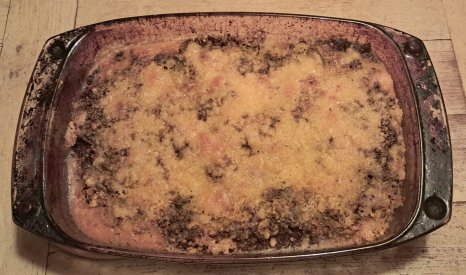
Zojuist heb ik de Sama Hoole Casserole (ovenschotel) gemaakt en gegeten. Het was een groot succes! Ik geef je hier mijn eigen recept, aangezien Hoole geen kruiden gebruikt.

Stap 1: Braad een pond rundergehakt in een ruime hoeveelheid boter en kruid dit in de pan (marineren vooraf niet nodig) met een ruime hoeveelheid kertiepoeder (ikzelf gebruik Hindoestaanse massala) en gemalen zwarte peper naar smaak (ik houd zelf van een flinke bite). Voeg een theelepel of eerlepel azijn (ikzelf gebruik Engelse malt vinegar, maar rodewijnazijn kan ook) en een theelepel of eetlepel zoute ketjap en een beetje Billington donkere melassesuiker (andere melassesuiker kan ook) toe. Bak het gekruide gehakt droog, totdat het rul wordt en laat het afkoelen, waardoor het nog ruller wordt.

Bekijk bijlage 39660

Stap 2: Klop 4 eieren.

Bekijk bijlage 39661

Stap 3: Bedek de bodem van een ovenschaal met het rulle, gekruide rundergehakt.

Bekijk bijlage 39662

Stap 4: Giet het geklopte ei over het gekruide gehakt en vermeng dit met elkaar.

Bekijk bijlage 39663

Stap 5: Strooi sterk smakende kaas over het gehakt vermengd met ei (ik gebruik een half zakje Grana Padano, dus ong. 75 gram).

Bekijk bijlage 39664

Stap 6: Bak deze schotel in de oven. Ikzelf zet de schotel eerst onderin om het ei te laten stollen en samen met het gehakt te laten bakken. Aan het eind zet ik de schotel zo hoog mogelijk om de kaas te gratineren.

Stap 7: Zo ziet de schotel er uit. Het wordt een soort hartige koek met een krokante bovenlaag. Je proeft alles: het vlees, de kruiden, de boter, de eieren en de kaas. Heerlijk!

Bekijk bijlage 39665

Sama Hoole gebruikt puur en alleen de dierlijke ingredienten als snaakmakers en voegt daarom bacon (bakspek) toe. Leef je uit, zou ik zeggen!

Mike
1000103437.jpg

Vandaag weer gemaakt. Heerlijk!

Mike
 
University debate: "Fruit and honey were the staples of the human evolutionary diet."

Nutritionist: "We're primates. Primates eat fruit. Our colour vision evolved to spot it, our sweet tooth evolved to want it, and the Hadza in Tanzania still get a sixth of their calories from honey. Sugar is ancestral."

Anthropologist: "What month is it in your ancestral forest?"

Nutritionist: "Sorry?"

Anthropologist: "Wild fruit comes in a window. A few weeks, then it's over. What's the fruit-eater doing in the other forty-five?"

Nutritionist: "Finding other fruit."

Anthropologist: "At latitude fifty, in January, forty thousand years ago, with the glacier a day's walk north. Name the orchard."

Nutritionist: "Humans evolved in Africa."

Anthropologist: "And left it. We've been in Europe and Siberia for forty-five thousand years, through an Ice Age, on nothing you'd recognise as a banana. The mammoth was the fruit."

Nutritionist: "The Hadza prove honey is a staple."

Anthropologist: "The Hadza climb thirty feet up a baobab, smoke out a hive, get stung half to death and come down with a comb full of grubs. They eat the grubs. Bee larvae are fat and protein. The honey is the wrapping, and it's a few weeks a year, on the equator."

Nutritionist: "It's still sugar, and they thrive on it."

Anthropologist: "So does a bear. He eats every berry on the mountain in September and sleeps till April. Fruit is how an animal gets fat on purpose before the food runs out. Our liver still does exactly that with fructose. You've taken a seasonal fattening switch and left it pressed down for twelve months."

Nutritionist: "Our sweet tooth is proof we were built for it."

Anthropologist: "Your sweet tooth is one receptor. You've got twenty-five for bitter, because most of what grows wants to poison you. A tongue built for fruit would be a tongue that could taste more than one of them."

Nutritionist: "What about the apple? The grape?"

Anthropologist: "The wild apple is a crab the size of a marble and tastes of battery. The wild banana is seeds held together by spite. Everything on your fruit bowl was bred in the last few thousand years to be a sweet nobody's ancestor ever met."

Moderator: "Closing statements."

Nutritionist: "Sugar from fruit is natural, ancient, and the body was designed to enjoy it."

Anthropologist: "The body was designed to enjoy it for three weeks and then go hunting. You've skipped the hunting and kept the three weeks going since 1980."

[The nutritionist had brought a banana. It stayed in the bag.]


Mike
 
A Nobel Prize-winning chemist fed cows no protein at all for years, and they gave milk, and the milk was full of protein.

Artturi Virtanen won his Nobel for chemistry in 1945.

In the 1960s he took dairy cows off every protein in their diet and fed them urea and ammonium salts, which are nitrogen and nothing else, with cellulose and starch for energy.

The cows made milk. Full milk, with every essential amino acid in it, for years, through several lactations.

The microbes in the rumen took the nitrogen and built the protein from scratch, and the cow digested the microbes.

They built every B vitamin as well, including B12, which no plant and no animal can make and which comes, in the end, from a microbe or nowhere.

A cow is the only farm animal that manufactures protein. A pig and a chicken can only move protein from one place to another, and the place is usually a soy field.

Feed a pig a kilo of soy protein and you get less than a kilo of pork. Feed a cow grass with no protein worth the name and you get a kilo of beef and milk anyway.

Grazing cattle produce more protein a human can eat than they consume.

A cow is a protein factory with a grass intake and a chemist-proof design, and she can run it on nitrogen and sunlight.

Every plant-based plan to replace her begins with growing the protein first.


Mike
 
Op 16 december 1960 werd een twaalfjarige jongen op een tafel gelegd in een ziekenhuis in San Jose, kreeg
hij elektroshocks toegediend tot hij bewusteloos was, en werd er een ijskrabber door het dunne bot boven elk oog geslagen en van links naar rechts door het frontale deel van zijn hersenen gehaald, omdat zijn stiefmoeder de dokter had verteld dat hij ongehoorzaam was. De rekening van de dokter bedroeg tweehonderd dollar.

Howard Dully was een grote, onhandige, dromerige jongen wiens moeder was gestorven toen hij vijf was, en wiens vader was hertrouwd met een vrouw genaamd Lou die hem niet kon uitstaan. Zij bracht hem naar zes psychiaters. Alle zes zeiden tegen haar dat het probleem niet bij de jongen lag. De zevende was Walter Freeman, die meer lobotomieën had uitgevoerd dan enige andere levende man, die tussen staatsziekenhuizen reed in een busje dat hij de lobotomobiel noemde en ze bij de tientallen deed op een middag, zonder handschoenen en zonder chirurgische opleiding, en die ooit vijfentwintig op één dag had gedaan. Freemans aantekeningen over Howard, die Howard vierenveertig jaar lang niet onder ogen kreeg, vermelden de symptomen. Hij protesteert tegen naar bed gaan. Hij zet het licht aan als het volop daglicht is. Hij reageert niet op liefde of op straf. Hij heeft een woeste kant. Op basis van dat bewijs, en Lous handtekening, en tweehonderd dollar, schreef Freeman dat de jongen zou profiteren van een transorbitale lobotomie en voerde hij die vier dagen later uit.

Howard herinnert zich de tafel. Hij herinnert zich dat hij wakker werd met twee zwarte ogen en koorts en geen idee wat er met hem was gebeurd, omdat niemand het hem vertelde, toen niet en later ook niet. Zijn vader sprak er nooit over. Lou liet hem het jaar daarop in een staatsinrichting opnemen, en de jongen met de gaten in zijn hersenen bracht de volgende veertig jaar door in en uit inrichtingen, jeugdgevangenissen, een gevangenis, opvanghuizen en op straat, drinkend, ronddolend, nooit helemaal in staat om te zeggen waarom hij was zoals hij was, met ergens een foto van een dokter in pak die boven een kind stond met een stalen pin in elke oogkas.

Op zesenvijftigjarige leeftijd, terwijl hij een schoolbus bestuurde, ging hij op zoek naar antwoorden. Hij vond zijn dossier in Freemans archief aan een universiteit in Washington, in het handschrift van de dokter zelf, en las voor het eerst wat zijn stiefmoeder had gezegd en wat de dokter ermee eens was geweest. Hij ging naar zijn vader, die tachtig was, en vroeg hem waarom hij het had laten gebeuren, en zijn vader zei dat hij erin was gepest. Howard vertelde het verhaal op de radio in 2005 en vijf miljoen mensen luisterden naar een man die huilde over een stuk papier.

Walter Freeman was geen kwakzalver. Hij was een professor in de neurologie, de man die de lobotomie naar Amerika had gebracht, en de operatie had zijn uitvinder in 1949 de Nobelprijs voor de Geneeskunde opgeleverd. De tijdschriften publiceerden hem. De ziekenhuizen boekten hem. De kranten noemden het een wonder. Hij deed het bij drieduizendenhalf mensen, negentien daarvan kinderen, en hij bleef het doen tot 1967, toen een patiënt op de tafel stierf en het ziekenhuis zijn bevoegdheden introk, en hij zijn laatste jaren doorbracht met het land doorkruisen in het busje om zijn oude patiënten op te zoeken en te bewijzen dat het had gewerkt.

Zo zag gevestigde wetenschap eruit vanbinnen, voor een twaalfjarige. Een klacht van een moeder, het zelfvertrouwen van een expert, een procedure met een prijs erachter, tweehonderd dollar, en een leven dat niemand kon teruggeven.

Dezelfde instellingen vertellen je nu wat je kind moet eten, in dezelfde toon, met dezelfde zekerheid, en het foldertje heeft een logo erop. Howard Dully is in de zeventig en kan nog steeds niet zeggen wat hem is afgenomen. Niemand heeft ooit zijn excuses aangeboden.
 
Every real omnivore on earth can live on a hedge, a bin or a carcass as the week requires, and you cannot live on the hedge.

A pig can live on acorns, roots, grass and a dead pig, and it does, and its gut is built for all four.

A bear can live on berries for a month, then salmon for a month, then nothing for six, and its molars are flat for the fruit and its claws are sharp for the fish.

A rat can live on anything that has ever been food, and some things that have not.

A raccoon can live on crayfish, corn, eggs and your rubbish, and it has the stomach acid to handle the rubbish.

A chicken can live on seed and insects and will take a mouse if one is slow enough.

A chimpanzee can live on fruit and leaves with the odd monkey, and more than half its gut is a fermenting colon to make the leaves worth eating.

You cannot live on the leaves. Your colon is a fifth the size of the chimp's and most of your gut is a long absorbing tube built for food already digested, which is meat and fat.

You cannot live on the grass, the acorns or the roots. Your gut cannot touch cellulose and your body is poisoned by half the roots.

You cannot live on the fruit. There is a month in the year a fruit tree feeds you and eleven when it does not.

You cannot live without B12, which no plant has, or without a fat the brain needs, which no plant has, and your stomach runs at the acidity of a vulture's.

An omnivore has a backup for every season. You have one food that works in all twelve months and it has hooves.

The pig is an omnivore. You are a carnivore that can tolerate a side salad.


Mike
 
The scan that finds cancer works by injecting radioactive sugar, because a tumour takes up more of it than the tissue around it.

Most cancer cells burn sugar the wasteful way, like yeast, so they need far more of it than healthy cells to keep growing.

The tracer is a fake sugar the cell swallows and cannot finish, so it gets trapped inside and glows.

On the screen, the cancer lights up from eating it.

The day before the scan, the patient is put on a low-carb, no-sugar diet.

If their blood sugar is still too high on the morning, the scan can be cancelled, because the sugar already in the blood would hide the tumour.

The hospital knows exactly what the tumour wants, and keeps it off the menu for one day.

Then Britain's biggest cancer support charity raises its money with coffee mornings full of cake.

Channel 4 raises money for Stand Up To Cancer with a celebrity Bake Off.

America's biggest breast cancer charity once sold pink buckets of fried chicken with KFC.

The tea trolley on the chemo ward comes round with biscuits.

Medicine finds the tumour with sugar, then holds a bake sale to fight it.


Mike


Aha, dit heb ik nog nooit onderzocht.

Mijn vader dient dus elk half en nu elk jaar een scan te ondergaan waarin ze vloeistrof inspuiten (die dacht ik fluo is) en dan doen ze een nucleaire scan volgens mij.

Na dat inspuiten echter moeten we wel 3h wachten en mag ie eten ???

Dus toch iets anders dan ?
 
Negen van de tien Amerikaanse aardbeien komen uit een paar valleien in Californië waar de grond voor elke aanplant wordt gedood met een gas uit de Eerste Wereldoorlog, en de velden zijn vanaf de weg zichtbaar omdat ze zijn ingepakt in plastic om het gas binnen te houden.

Chloropicrin werd gemaakt voor de loopgraven. Het was een long- en oogmiddel, een braakmiddel, afgevuurd in granaten om mannen uit hun maskers te dwingen. Nu wordt het elk jaar in de grond gespoten in Watsonville en Oxnard, onder zeilen die de dampen een week lang vasthouden, en het doet met de grond wat het deed met een loopgraaf: alles erin sterft, de schimmels, de bacteriën, de wormen, de insecten, totdat de aarde zo steriel is als een ziekenhuisblad. Dan gaan de aardbeien erin, op verhoogde bedden van plastic, gevoed door druppelirrigatie met alles wat een levende grond hun zou hebben gegeven, en het plastic en het gas komen volgend jaar weer terug, want een dode grond heeft geen verweer tegen de ene ziekte die erdoorheen komt.

Veertig jaar lang was het gas broommethyl, dat de ozonlaag aantast, en toen de wereld het in 2005 verbood, regelden de aardbeienteelers van Californië een vrijstelling voor zichzelf en bleven het nog een decennium gebruiken, de laatste grote gewasproducent op aarde die dat deed. Chloropicrin was de vervanger, en de eigen pesticideregulator van de staat zet het op de lijst van de meest voorkomende oorzaken van vergiftiging van landarbeiders in Californië. De mannen die het aanbrengen zijn meestal ongedocumenteerd, de afdrift heeft een school in Monterey County ontruimd, en de aardbei staat al de meeste tijd van het afgelopen decennium bovenaan de lijst van het meest met pesticiden besmette voedsel in Amerika.

Elk jaar noemt de industrie het een hartgezond antioxidant-superfood, en elk jaar wordt het veld waar het vandaan komt vergast.

De koe in de wei ernaast heeft nog nooit een gesteriliseerde grond onder haar hoeven nodig gehad. De aardbei kan niet op die schaal worden geteeld zonder, en het oorlogsgas is de prijs van een bakje in januari.
 
Given the choice between sweetened water and cocaine, 94% of rats picked the sweet water.

Bordeaux, 2007. Two levers in a cage. One sends a dose of cocaine straight into a vein. The other delivers a sip of sweetened water.

It took the rats 11 days to develop a reliable taste for cocaine over nothing at all.

It took them two days to prefer the sweet water over the cocaine.

The researchers raised the cocaine dose. The rats stayed loyal to the water.

They brought in rats already hooked and escalating their own doses. Those switched to the water as well.

They swapped the sweetener for ordinary table sugar. Same result.

The sweet receptor on your tongue was built for a world where sweetness meant a handful of berries in August, and nobody has updated the hardware.

Hit it every hour from a carton and the reward lands harder than anything that receptor was designed to expect.

Only one of those two levers can get you arrested. The other one comes with a cartoon tiger.


Mike
 
Medieval peasant eating does the rounds online every few months as clean, wholesome living, so a wellness creator went back to 1250 to interview one.

Creator: "So, your diet. Whole grains, legumes, seasonal veg, nothing refined. You're basically a role model."

Peasant: "Pottage."

Creator: "Love that. What's in it?"

Peasant: "Whatever came up. Beans, peas, a leek. Oats, if the oats came up."

Creator: "And bread?"

Peasant: "Rye. Ground at the lord's mill. He keeps a share for the grinding, and he keeps you if you grind it at home."

Creator: "Is the rye organic?"

Peasant: "Some wet years it grows black spurs. Those years the village sees angels and the fingers go black and fall off."

Creator: [writing this down] "Wild. Like a cleanse."

Creator: "All that fibre, though. Your gut must be incredible."

Peasant: [opens his mouth: the teeth are worn flat to the gum by the grit that comes off the millstone]

Creator: "Gosh. Okay. And the children? Thriving, I bet, all this fresh air."

Peasant: "They do well on the breast. Then we wean them onto pottage, and we stop counting them until Easter."

Creator: "Any meat at all?"

Peasant: "The pig. He's killed at Martinmas and he has to last until the pig after him. We eat him an inch at a time."

Creator: "And the deer in the wood?"

Peasant: "The deer belong to him. Touch one and he takes your hand. There's a man in the next village who looked at one too long and now sees with the other eye."

Creator: "Last question. If you could eat anything at all, what would it be?"

Peasant: [looks up the hill at the manor]

Peasant: "Whatever he's having."

Creator: "Which is?"

Peasant: "Venison. Beef. Swan. A pike as long as your arm. Cheese by the wheel. Butter he doesn't have to sell."

Creator: [lowering the phone] "That's quite meat-heavy."

Peasant: "He's a head taller than me as well. His father was a head taller than mine. We've noticed."

Narrator: The video went out as "30 days eating like a medieval peasant". It recommended oats. Nobody in it mentioned the pig, the lord, or the hand.


Mike
 
In November 1941 the richest man in America drove his twenty-three-year-old daughter to a hospital in Washington without telling her mother, had two surgeons drill holes in her skull and cut into the front of her brain while she sang God Bless America to them, and when the singing stopped she had a mental age of two and the family did not speak her name for twenty years.

Rosemary Kennedy was the third child and the first girl, and she was slow. A nurse at the birth had held Rose Kennedy's legs together for two hours while they waited for the doctor, and the baby had been starved of air. She learned to read and write, but late, and in a family where the boys were being bred for the presidency and the girls for the right marriage, she was the one who could not keep up, the one who had to be coached and watched and given the simpler part in the photograph. She was also, by every account, the prettiest of them, and when the family went to London in 1938 she was presented at court in a white dress and curtsied to the King without a mistake.

Then she was twenty-one, and the trouble started. Moods. Rages. Slipping out of the convent school at night and coming back in the morning and not saying where. The nuns said she might be meeting men. For Joseph Kennedy, who was managing his sons towards the White House and could not have a daughter who might get pregnant or get talked about, that was the end of it. He had read about a new operation. Walter Freeman had promised the newspapers it calmed the agitated, and Joe Kennedy had never in his life been told that a thing he could pay for would not work.

Rosemary was given a mild sedative and kept awake. Freeman and his surgeon, James Watts, opened the skull on both sides and Watts pushed a blade into the frontal lobes and swept, while Freeman asked her to recite the Lord's Prayer and sing, and count backwards, so they would know how far to go. They went until she was incoherent. Then they stopped.

She came out of it unable to walk or speak. Years of therapy got her a few words and a limp. Joe moved her to a private hospital in New York and then to a convent school in Wisconsin, told the family she was teaching the retarded in the Midwest, and never went to see her. Rose, her mother, was not told what had been done until long after, and did not visit for twenty years. The brothers and sisters, including the one who became President, were told she was away. When Joe had his stroke in 1961 and could no longer manage the story, Eunice went to Wisconsin and found a woman of forty-three who did not know her, and came home and started the Special Olympics.

Rosemary lived to eighty-six, in the convent, and died in 2005 with her surviving sisters at the bed. The brother who became President had signed the first federal mental health law in 1963, and the family has said she was the reason.

Freeman kept operating for another twenty-six years. His notes on Rosemary have never been released.

That is what the expert's confidence looks like when it meets a powerful man with an inconvenient child. The science was published. The father was certain. The daughter sang to the surgeon until she could not.

Every institution that has ever decided it knows what is wrong with you and how to tidy it has the same two ingredients in the room, and the person on the table is still the only one who pays.


Mike
 
There is a queue at six in the morning outside a barbecue restaurant in Austin, Texas, that runs for five hours, and the people in it are waiting for a brisket with the fat left on, cooked for eighteen hours over oak by a man who has said the fat is the whole point.

Aaron Franklin opened in a trailer in 2009 and has been named the best barbecue in America by everyone who hands out that title. The food is Texas, which means beef, and the beef is the brisket: the whole chest muscle of a steer, twelve to fifteen pounds, with a cap of white fat an inch thick across the top, which most of the country would trim off and throw away. Franklin trims it to a quarter inch and leaves it, and as the brisket sits in the smoke the fat renders down through the meat for most of a day, until the lean is soaked and the cap is a soft dark bark. He has written that the fat is what carries the smoke and the salt, and that a lean brisket is a waste of a cow.

He went on television in a cap and a T-shirt and taught the technique to a nation that had been told for forty years to buy the lean cut, and the nation drove to Austin. People fly in. They bring chairs. They sell out by one in the afternoon, every day, and he has never once sold a turkey breast as a substitute.

The thing on the chopping block, sliced thick, glistening, with the fat the colour of amber and the crust black, is the oldest food in Texas: a cheap tough cut of the animal, made glorious by heat and time and nothing else. There is white bread on the side and a pickle, and that is the meal.

The leaflet says to trim the visible fat. Five hundred people a day stand in the Texas sun for the man who ignores it.


Mike
 

Forum statistieken

Onderwerpen
4.740
Berichten
646.316
Leden
8.714
Nieuwste lid
Monica Hop
Word vaste donateur van dit forum
Terug
Bovenaan